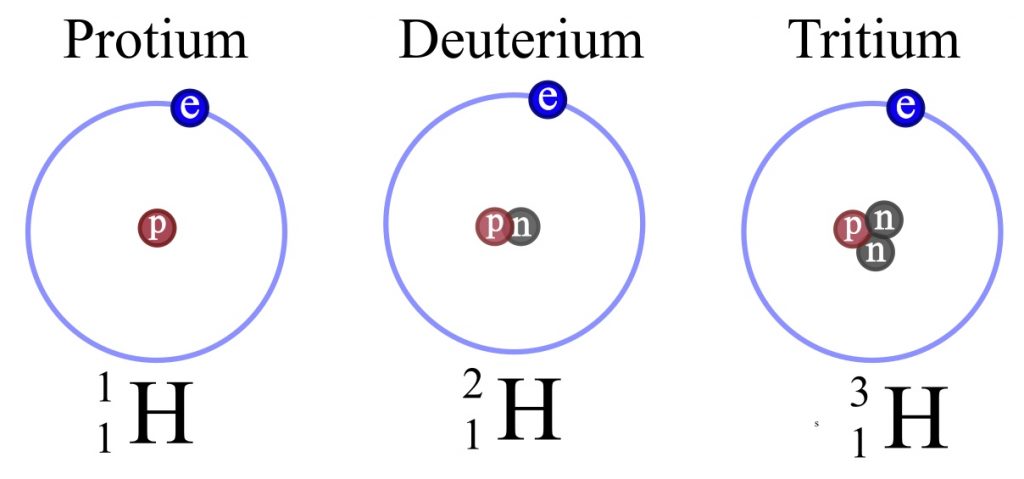
The manufacture of all the elements of the periodic table is the result of nucleosynthesis within stars, successively heavier elements are created by combining the atoms that form the nuclei of lighter elements. The most abundant element in the observable Universe is Hydrogen, which occurs in three “flavours” or isotopes, the simplest form, Protium, consisting of a single proton orbited by a single electron.
Fig 1: The three isotopes, or flavours, of Hydrogen, the most abundant element in the observable Universe.
It is currently believed that as the Universe began to cool, following the big bang and expansion, forces started to form quarks and gluons together, this formed the Protons, electrons and Neutrons we see making up the Observable Universe. As this matter continued to cool, other forces, such as the strong and weak Nuclear forces, began to make themselves felt, this forced particles together and within a very short period the majority of the particles in that early Universe were formed into the three isotopes of Hydrogen and also, Helium, the second most abundant element in the Universe.
Helium, like Hydrogen, occurs is more than 1 natural isotope, or flavour;
Figure 2: The two naturally occurring isotopes of Helium.3He consists of 2 Protons and a Neutron, 4He is 2 Protons and 2 Neutrons. Both have a pair of electrons orbiting under normal circumstances. Ionisation can add or remove electrons which changes the electrical properties of the atom.
As the hydrogen and helium formed in the early universe some parts had a greater density than others. As gravity built due to the increased mass this hydrogen and helium began to form large clouds, momentum likely caused motions within the clouds and also forced them to rotate. Eventually some of these clouds became large enough that they were drawn inward by their own gravity, becoming ever denser at the heart of the cloud. As the atoms were drawn in they jostled together, something they don’t like to do, this friction created infra-red radiation (heat) that put increasing amounts of energy into the atoms, increasing the velocity they moved within the cloud.
Over a period of time the core of the cloud became dense enough and hot enough that the motion of the atoms was able to overcome the strong nuclear forces, which normally keeps atoms well away from each other, this caused the atoms to “crash” into each other, these collisions caused the atoms to “fuse” together, release energy and create heavier atoms. These early stars were true behemoths, hundreds of times the mass of our Sun and the majority of stars we see in the Universe today. However, the fusion of hydrogen nuclei, single proton nuclei, to form atoms consisting of two protons (Helium) is the method by which all stars, those in the early Universe, and today, produce energy and start the process of nucleosynthesis.
All stars produce heavier elements but the types of elements they produce is dependent on their mass and how they end their lives. The more massive stars produce heavier elements throughout their lives, but the truly heavy elements, those above 56Ir (Iron) are only created during Supernova events.
Main sequence stars, those that are producing their energy via hydrogen fusion can be any mass, ranging from the smallest stars, that may live for trillions of years, to stars like the Sun, which may live for 10 billion years to the Supergiants, like Betelgeuse, which are 10 to 20 times the mass of the Sun and only live for an estimated 10-15 million years, to stars like Eta Carina that may be more than 100 times the mass of the Sun, and only live for around 1 million years.
As the Sun ages it will become a Red Giant, not because it will increase in mass, actually the opposite is true, but because as it ages, the core fills up with Helium, slowing the fusion process in its core, resulting in less energy production, resulting in gravity increasing it’s grip and squeezing it, the core, ever denser, at the same time the outer layers of the Sun, in fact all main sequence stars, will cool and feel less of gravity’s grip, so they swell. The core will heat as the atoms are squeezed together, the result will be Helium fusion within the core, producing Carbon atoms , at a temperature of around 100 million degrees Kelvin, this period for the Sun may last about 1 billion years, but the Sun lacks sufficient mass to fuse Helium and Carbon.
Heavier starts will continue this process, as each new “core”, which is in fact a layer atop the true core, fuses elements to make heavier elements, gravity continues to make itself felt and crushing the core more. Obviously, the speed with which this process occurs depends on the mass of the star.
For Supergiant stars, in the mass range of 10-20 solar masses, the burning of helium to produce heavier elements then continues for around a million years. The alpha-process (Alpha particles (radiation) are actually Helium nuclei) then combines helium with carbon to produce heavier elements, but only those with an even number of protons.
The elements grow in this order;
12Carbon + 4Helium = 16Oxygen
16Oxygen + 4Helium = 20Neon
20Neon + 4Helium = 24Magnsium
24Magnesium + 4Helium = 28Silicon
28Silicon + 4Helium = 32Sulfur
32Sulfur + 4Helium + 4Helium = 40Argon
40Argon + 4Helium = 40Calcium
40Calcium + 4Helium + 4Helium = 48Titanium
48Titanium + 4Helium = 52Chromium
52Chromium + 4Helium = 56Iron
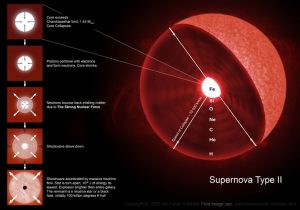
There are other fusion pathways that create the elements with odd numbers of protons. 56Iron has such a tightly bound nucleus that conventional fusion cannot proceed to create heavier elements beyond this point. Without fusion in the core, there is insufficient energy within the core to prevent the immense gravity of the star causing it to undergo a core collapse – the star has become a Type II Supernova.
Physicist Lawrence Krauss has suggested that it may only take 100,000 years for the carbon to fuse into oxygen, perhaps only 10,000 years for the oxygen to fuse into silicon, and perhaps only one day for the silicon to fuse into iron, heralding the collapse of the star.
When the star’s core collapses, and it becomes a Type II Supernova, the energy released is sufficient that 56Iron atoms can be fused with additional elemental nuclei and allow the death of the star to seed the surrounding environment with every element we know of.
Astronomer Carl Sagan in the TV series “Cosmos” noted, “We are made of star-stuff.” Krauss agreed, stating that “every atom in your body was once inside a star that exploded…The atoms in your left hand probably came from a different star than in your right hand, because 200 million stars have exploded to make up the atoms in your body.”
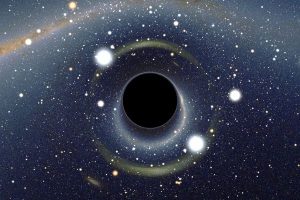
Black holes are some of the most enigmatic but fascinating objects in the Universe. They appear to be the final chapter in the life of massive stars, packing material in so densely that the gravitational field is so strong that electromagnetic radiation (light to you and me) cannot escape. The point at which this happens is called the Schwarzschild Radius, or commonly referred to as the Event Horizon. The name derives from the German astronomer, Karl Schwarzschild, who calculated this in 1916 as a solution to Einstein’s General Theory of Relativity, published the year before, in which Einstein first predicted the existence of black holes.
The story goes that in December 1967, when these were still theoretical objects, a student reportedly suggested the phrase “black hole” at a lecture by American Astronomer John Wheeler.Wheeler adopted the term for its brevity and it quickly caught on, leading some to credit Wheeler rather than the student. Other terms had been used prior to the 1960’s such as “Dark Star” or “gravitationally collapsed object”, none truly caught on. Black Hole, itself, had been used previously, but it was not widely adopted until after the Wheeler lecture for which he has been credited.
The first Black Hole candidate was not discovered until 1971.
So far, astronomers have identified three types of black holes:
Stellar Mass Black Holes: Ranging from 10 to 100 solar masses
Intermediate Mass Black Holes: Ranging from 10,000 to 100,000 solar masses
Super Massive Black Holes: < 1 million Solar Masses
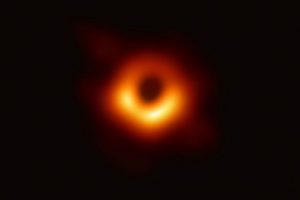
The Event Horizon Telescope, a planet-scale array of eight ground-based radio telescopes forged through international collaboration, captured this image of the supermassive black hole in the center of the galaxy M87 and its shadow. (Image credit: EHT Collaboration)
Lets deal with these very different beasts.
Stellar Mass Black Holes
As we discussed in the article on Supernova, when a star burns through the last of its nuclear fuel it undergoes a core collapse . For stars from around 8 to 20 times the Sun’s mass they will leave a collapsed core called a neutron star , stars below around 8 solar masses leave a collapsed core called a white dwarf. When stars have a final mass in excess of 25 solar masses it is believed that the final mass of the collapsed core exceeds the Tolman–Oppenheimer–Volkoff limit of 2.1 Solar Masses, when this happens, as current thinking holds, the core continues to collapse past the Neutron degeneracy point and the end result is a black hole with a mass equivalent to the collapsed core.
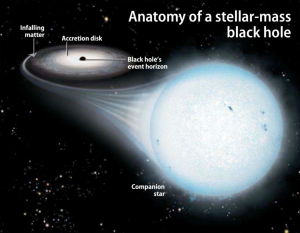
Anatomy of a Stellar Mass Black hole, identifying important parts.
Black holes that formed from the collapse of individual stars are physically very small, astronomically speaking, but they are incredibly dense. One stellar mass black hole can pack 3 times the mass of the sun into something that is barely larger than a decent mid sized city. The result is a very small, but very intense gravitational field surrounding this object that has an immense pull on anything that comes close enough to be ensnared by it’s gravity.
Any material that strays close enough to the black hole will be captured and pulled into ever tighter orbits, eventually it will be stripped apart, split into individual atoms, heated and inexorably pulled toward the event horizon, from which there is no escape.
NASA’s Chandra Answers Black Hole Paradox
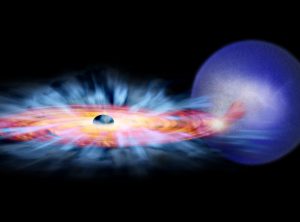
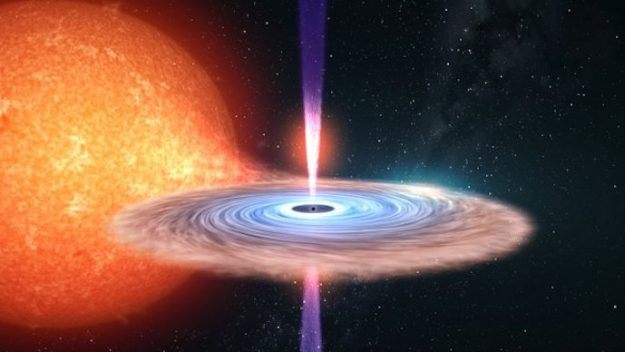
As the matter falls toward the event horizon it forms what is called an accretion disk around the equator of the black hole, just as gas and dust form a disk around a star. Once this matter is heated and stripped, it becomes ionised, it glows across the whole electromagnetic spectrum, emitting copious quantities of X-rays and even gamma rays into the surrounding space. As long as there is material falling on the object, it will glow and be detectable, once it has “eaten” all the material in its immediate vicinity, it will go quiet, almost undetectable, until something strays too close and the process starts again, even whole stars can be stripped by these monsters of the dark.
Stellar mass black hole stripping material from it’s binary partner (Artists impression. Courtesy Harvard Smithsonian Institute for Astrophysics)
An intermediate mass black hole (IMBH) is a type with mass in the range 100 to 10,000 solar masses, this is significantly more than stellar mass black holes but dramatically less than the < 1 million solar mass supermassive black holes found in the very heart of large galaxies. A number of IMBH candidate objects have been discovered in our galaxy and other galaxies nearby, this evidence is based on indirect gas cloud velocity and accretion disk spectra observations.
The most compelling evidence for IMBHs comes from a handful of low-luminosity active galactic nuclei. Astronomers believe that because of their observed activity these galaxies contain black holes that are actively accreting material from their surroundings. An example of one such IMBH is a spiral galaxy, NGC 4395, at a distance of about 13 million light years (4 Million parsecs) appears to contain a black hole with mass of about 36,000 solar masses.
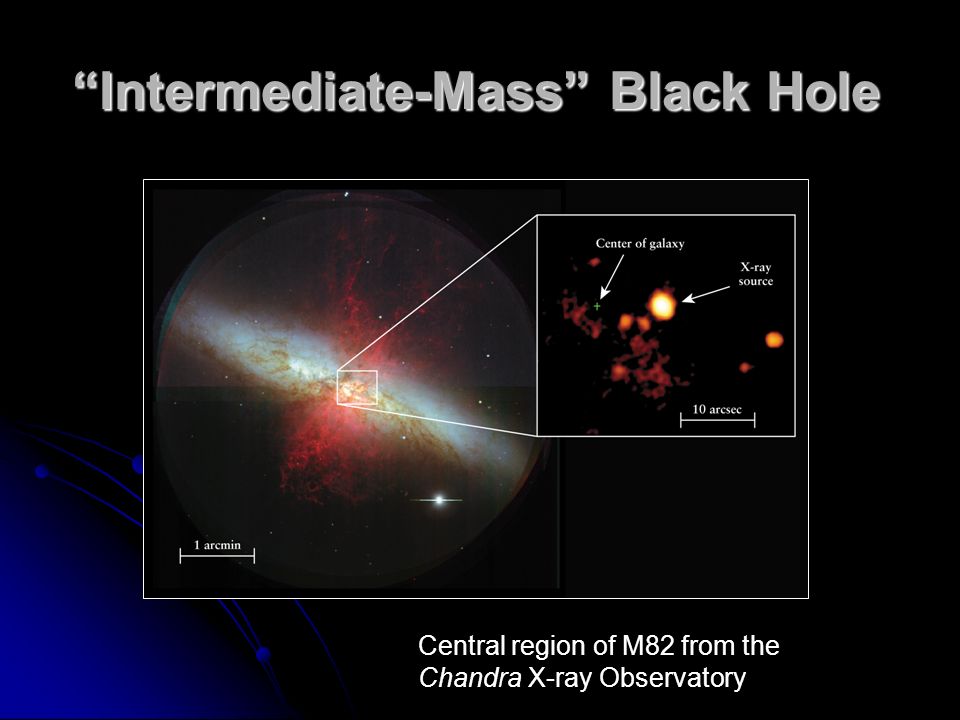
Astronomers further believe that some ultra-luminous X ray sources in nearby galaxies are suspected to be intermediate mass black holes, with masses in the range of a 100 to a 1000 solar masses. These intermediate black holes are observed in star-forming regions, such as in the starburst galaxy M82, and are appear associated with young star clusters , also common in these areas of galaxies. The only way to be sure is to undertake a dynamic mass measurement based on the orbit of any binary star orbiting the suspected intermediate mass black hole, and this is far from a simple task, especially given the distances and associated angular separation of these objects.
Astronomers have suggested a handful of globular clusters may contain intermediate mass black holes, these claims are based on measurements of the velocities of stars near the centre of the globular cluster. To date, none of these candidates have stood up to further scrutiny and their existence is still unconfirmed. Some of the objects claimed to exist, such as one in the globular cluster M31-G1, (a companion of the galaxy M31) are not required to explain the movement and the velocity of the stars within the cluster.
So where did these Intermediate Mass Black Holes come from, they are too big to be from collapsed stars, and too small to be at the cores of galaxies, so we have a mystery, one yet, we do not know the answer too.
The theories as to their origins can be broken down into three basic premises;
They formed at the start of the Universe immediately after the big bang.
They formed from the merger of multiple stellar mass black holes and other compact objects (Neutron stars and white dwarves) as well as the accretion of material from supergiant stars.
They form from the direct collision of supermassive stars in dense stellar clusters, such as globular clusters and the accretion of material from their surroundings.
Research continues to discover confirmed Intermediate mass black holes, but whilst there are an increasing list of candidates, none have, so far, been confirmed, though many claimed.
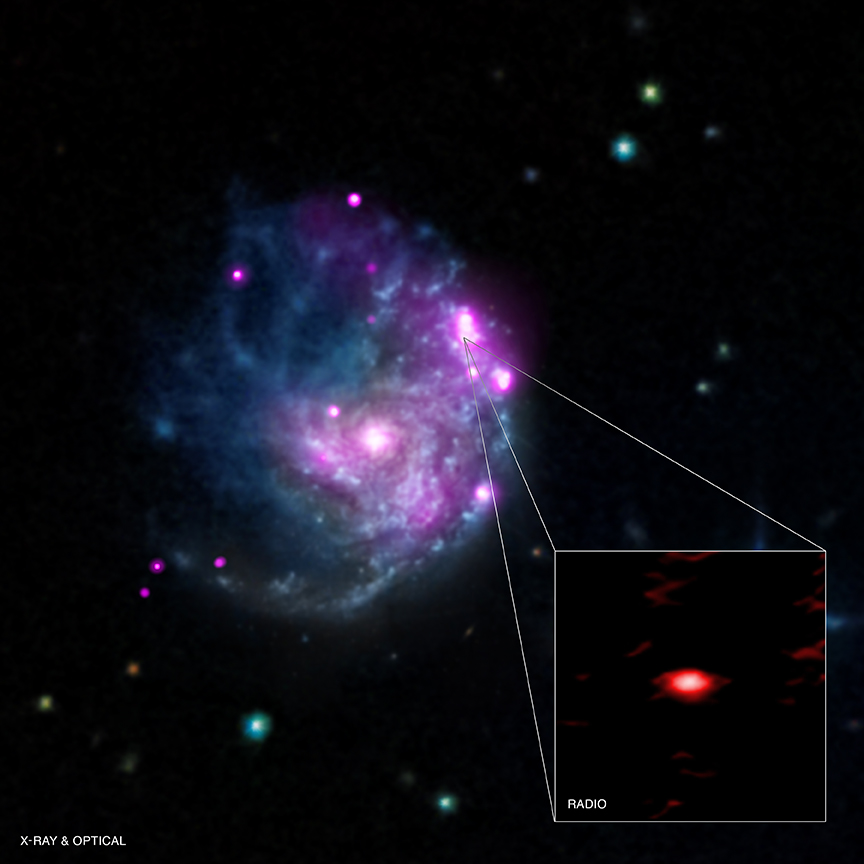
A newly discovered object in the galaxy NGC 2276 may prove to be an important black hole that helps fill in the evolutionary story of these exotic objects. This source, known as NGC 2276-3c, is likely an intermediate-mass black hole with about 50,000 times the mass of the Sun. The main graphic shows a composite image of the whole galaxy, with X-rays from Chandra (pink) and optical data (red, green, and blue). The inset zooms into just NGC 2276-3c and reveals its emission in radio waves, including a jet produced by the black hole that appears to be squelching star formation. By combining the X-ray and radio data, astronomers are learning about the properties of this object and how it influences its surroundings.Chandra finds compelling evidence for an Intermediate Mass Black Hole inn the massive Galaxy M82.
Super-Massive Black Hole (SMBH)
So called super-massive black holes (SMBH) is the largest class of black hole, these have a mass ranging from a few 100,000’s to billions of times the mass of our Sun. It is believed these were formed in the very earliest moments of the aftermath of the big bang or shortly after from the collapse and merger of supermassive stars.
Observational evidence indicates that nearly all large galaxies contain a super-massive black hole, located at the galaxy’s centre. In the case of the Milky Way, the supermassive black hole corresponds to the location of Sagittarius A* at the Galactic Core. It is believed that accretion of interstellar gas, from collisions with stars, and possibly other black holes with supermassive black holes is the process responsible for powering quasars and other types of active galactic nuclei.
Super-massive black holes have properties that distinguish them from lower-mass classifications. First, the average density of a SMBH (defined as the mass of the black hole divided by the volume within its Schwarzschild radius) can be less than the density of water. This is because the Schwarzschild radius is directly proportional to its mass, and since the volume of a spherical object is directly proportional to the cube of the radius, the density of a black hole is inversely proportional to the square of the mass, and thus higher mass black holes have lower average density. In addition, the tidal forces in the vicinity of the event horizon are significantly weaker for supermassive black holes. The tidal force on a body at the event horizon is likewise inversely proportional to the square of the mass. A person on the surface of the Earth and one at the event horizon of a 10 million black hole experience about the same tidal force between their head and feet. Unlike with stellar mass black holes, one would not experience significant tidal force until very deep into the black hole.
Some astronomers have begun labelling black holes of at least 10 billion solar masses as ultra-massive black holes. Most of these (such as TON 618) are associated with exceptionally energetic quasars.
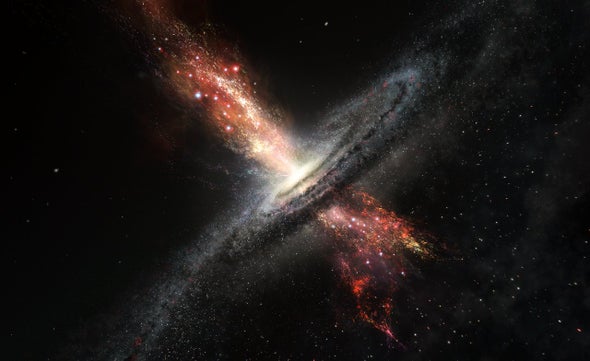
Artists representation of a Super-massive Black hole inside a galactic core radiating masses of energy as a Quasar
What is the Schwartzschild Radius or Event Horizon?
The Schwarzschild radius is a physical parameter that shows up in the Schwarzschild solution to Einstein’s field equations, this corresponds to the radius defining the event horizon, the point at which the escape velocity of the black hole exceeds the speed of light, and thus, not even light can cross, of a black hole.
The Schwarzschild radius was named after the German astronomer Karl Schwarzschild, who calculated this a solution 1916 in response to the field equations in Einstein’s General Relativity, which had been published the year before.
The Schwarzschild radius is given as
where G is the gravitational constant,
M is the object mass
c is the speed of light in a vacuum. (299,792.458 km/s or 299,792,458 m/s)
The Schwarzschild radius of an object is proportional to the mass. Accordingly, the Sun has a Schwarzschild radius of approximately 3.0 km (1.9 mi), whereas Earth’s is only about 9 mm (0.35 in) and the Moon’s is about 0.1 mm (0.0039 in). The observable universe’s mass has a Schwarzschild radius of approximately 13.7 billion light-years.
If an object has a radius smaller than its calculated Schwarzschild radius then it is, by definition, a black hole. The surface at the Schwarzschild radius acts as an event horizon in a non-rotating body (a rotating black hole operates slightly differently). Neither light nor particles can pass back through this surface once they cross within.
Anatomy of a Black Hole.
Singularity
At the centre of a black hole, as described by general relativity, may lie a gravitational singularity, a region where the spacetime curvature becomes infinite. For a non-rotating black hole, this region takes the shape of a single point and for a rotating black hole, it is smeared out to form a ring singularity that lies in the plane of rotation. In both cases, the singular region has zero volume. It can also be shown that the singular region contains all the mass of the black hole solution. The singular region can thus be thought of as having infinite density.
Photon sphere
The photon sphere is a spherical boundary of zero thickness in which photons that move on tangents to that sphere would be trapped in a circular orbit around the black hole.
For non-rotating black holes, the photon sphere has a radius 1.5 times the Schwarzschild radius. Their orbits would be dynamically unstable, hence any small perturbation, such as a particle of in-falling matter, would cause an instability that would grow over time, either setting the photon on an outward trajectory causing it to escape the black hole, or on an inward spiral where it would eventually cross the event horizon.
Ergosphere
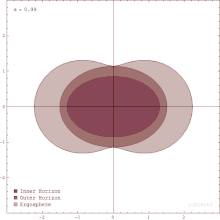
Rotating black holes are surrounded by a region of spacetime in which it is impossible to stand still, called the ergosphere. This is the result of a process known as frame-dragging; general relativity predicts that any rotating mass will tend to slightly “drag” along the spacetime immediately surrounding it. Any object near the rotating mass will tend to start moving in the direction of rotation. For a rotating black hole, this effect is so strong near the event horizon that an object would have to move faster than the speed of light in the opposite direction to just stand still.
The ergosphere of a black hole is a volume whose inner boundary is the black hole’s oblate spheroid event horizon and a pumpkin-shaped outer boundary, which coincides with the event horizon at the poles but noticeably wider around the equator. The outer boundary is sometimes called the ergosurface.
Objects and radiation can escape normally from the ergosphere. Through the Penrose process, named for Roger Penrose who calculated it, objects can emerge from the ergosphere with more energy than they entered. This energy is taken from the rotational energy of the black hole causing the latter to slow.
In the presence of strong magnetic fields, a variation of the Penrose process, the Blandford–Znajek process, is considered the most likely mechanism for the enormous luminosity and relativistic jets of quasars and other active galactic nuclei.
The Ergosphere of a black Hole.
The Event Horizon
The defining feature of a black hole is the appearance of an event horizon—a boundary in space-time through which matter and light can pass only inward towards the mass of the black hole. Nothing, not even light, can escape from inside the event horizon. The event horizon is referred to as such because if an event occurs within the boundary, information from that event cannot reach an outside observer, making it impossible to determine whether such an event occurred.
As predicted by general relativity, the presence of a mass deforms space-time in such a way that the paths taken by particles bend towards the mass.At the event horizon of a black hole, this deformation becomes so strong that there are no paths that lead away from the black hole.
To a distant observer, clocks near a black hole would appear to tick more slowly than those further away from the black hole. Due to this effect, known as gravitational time dilation, an object falling into a black hole appears to slow as it approaches the event horizon, taking an infinite time to reach it.[ At the same time, all processes on this object slow down, from the view point of a fixed outside observer, causing any light emitted by the object to appear redder and dimmer, an effect known as gravitational red-shift. Eventually, the falling object fades away until it can no longer be seen. Typically this process happens very rapidly with an object disappearing from view within less than a second.
On the other hand, indestructible observers falling into a black hole do not notice any of these effects as they cross the event horizon. According to their own clocks, which appear to them to tick normally, they cross the event horizon after a finite time without noting any singular behaviour; in classical general relativity, it is impossible to determine the location of the event horizon from local observations, due to Einstein’s equivalence principle.
The shape of the event horizon of a black hole is always approximately spherical. For non-rotating (static) black holes the geometry of the event horizon is precisely spherical, while for rotating black holes the event horizon is oblate
Evaporation
In 1974, the late Stephen Hawking mathematically predicted that black holes emit small amounts of thermal radiation, this has become known as Hawking radiation.
By applying quantum field theory to a static black hole background, he determined that a black hole should emit particles that display a perfect black body spectrum. Since Hawking’s publication, many others have verified the result through various approaches. If Hawking’s theory of black hole radiation is correct, then black holes are expected to shrink and evaporate over time as they lose mass by the emission of photons and other particles.
The Hawking temperature, the point at which the black hole emits radiation, is proportional to the surface gravity of the black hole, which, for a Schwarzschild black hole (none rotating), is inversely proportional to the mass. Hence, large black holes would emit less radiation than small black holes.
A stellar black mass hole of 1 solar mass has a Hawking temperature of ~0.0000000062 kelvins. This is far less than the 2.7 K temperature of the cosmic microwave background radiation. Stellar mass, or larger black holes, receive more mass from the cosmic microwave background than they lose from the emission of Hawking radiation, thus will always grow.
To have a Hawking temperature larger than 2.7 K, and thus be able to evaporate, a black hole would need a mass less than the Moon (7.34767309 × 10²² kilograms), or 1/80th Earth’s mass, however, a black hole this small would have a Schwarzschild radius of less than a tenth of a millimetre.
If a black hole is very small, the radiation effects are expected to become very strong. A black hole with the mass of a car would have a diameter of about 10−24 m and take a nanosecond to evaporate, during which time it would briefly have a luminosity of more than 200 times that of the Sun.
For such a small black hole, quantum gravitation effects are expected to play an important role and could hypothetically make such a small black hole stable, although current research in the impacts of quantum gravity do not indicate this is the case.
The Hawking radiation for an astrophysical black hole is predicted to be very weak and would thus be exceedingly difficult to detect from Earth. A possible exception, however, is the burst of gamma rays emitted in the last stage of the evaporation of primordial black holes. Searches for such flashes have proven unsuccessful.
NASA’s Fermi Gamma-ray Space Telescope, launched in 2008, will continue the search for these flashes. If black holes evaporate via Hawking radiation, a solar mass black hole will evaporate, a process that cannot start until the temperature of the cosmic microwave background drops below that of the black hole, over a period of 1064 years, a time span significantly longer than the life of the Universe to date.
A supermassive black hole with a mass of 1011 (100 billion)solar masses will evaporate in around 2×10100 years. Some monster black holes in the universe are predicted to continue to grow up to perhaps 1014 solar masses during the collapse of super clusters of galaxies. Even these would evaporate over a timescale of up to 10106 years.
The story of Betelgeuse has kicked things off, so it seems appropriate to discuss Supernova.
I am sure if I asked the question;
“What is a Supernova“
Most would answer the obvious,
“An old star exploding at the end of it’s life“
Whilst true, it is also not accurate either.
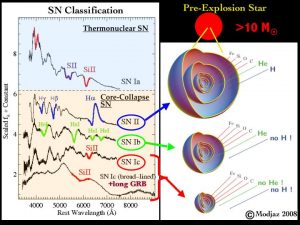
There was a time when a Supernova was just a Supernova, but then researchers realised that there were different types of Supernova, initially they were Type I and Type II. However, is soon became apparent that things were not as simple as that, so lets take a look at the different types of Supernova, what causes a star to become one, and what type of star becomes what type of Supernova.
Researchers found that when they looked at certain types of Supernova explosion there was a lack of Hydrogen visible in the spectra of the exploded star. Whilst the spectra shows very little hydrogen it does show a lot of carbon; they also show silicon, calcium, and elements up to iron (the result fusion during the intense explosion). It was soon realised that this was a new type of Supernova, one caused not by the collapse of the core of a Supergiant star, but rather by the collapse of a White-Dwarf star, the remnant of a star no too dissimilar to the Sun.
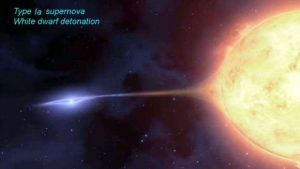
A White Dwarf cannot simply collapse all by itself, it needs to exceed 1.4 solar masses (2.765×10E30 kg), the Chandrasekhar Limit for White Dwarf Stability. All observed Type Ia supernova fall into two categories;
A binary Star system where a giant or Supergiant has expanded as it ages and fills it’s Roche Lobe, material then falls on the white dwarf star, forming an accretion disk at first, which may actually cause a repeating Nova in the first instance, but when enough material coalesces on the White dwarf and it’s mass exceeds the Chandrasekhar limit, collapse of the White dwarf is guaranteed.
When the White Dwarf, which is composed mostly of Carbon, collapses under the force of gravity, the temperature rises dramatically, this results in the fusion of carbon into new elements, however, this carbon detonation is catastrophic for the White Dwarf, the result is a massive explosion that we call a Type Ia Supernova.
Type Ia Supernova can also be the result of the collision of two White Dwarf Stars.
Type Ib Supernova
This type of Supernova is also noted for the lack of Hydrogen in the spectra, but unlike Type Ia above, they show helium. It is believed that this type of Supernova results from the collapse of stars more than 25 times the mass of the Sun.
As the stars evolve along the asymptotic giant branch of the H-R diagram they shed their outer layers, these are the stars we now believe evolve into Red Hypergiants, back into Yellow and Blue Supergiants and later explode in a Type Ib supernova explosion, as happened to Sanduleak-69+202 in 1987, resulting in the Supernova SN1987A.
As the star sheds mass it’s gravitational force reduces, thus allowing it to continue burning fuel at it’s core, however, as with Type II supernova, once the core of the star has an Iron mass more than 1.4 times the mass of the Sun it explodes as a Supernova.
Type Ic Supernova
As with the Type 1b, these show little to no Hydrogen or helium in their spectra, but other aspects of them are different from standard Type Ib, these are little understood at the moment, but researchers believe that they are, like Type Ib, stripped cores of truly massive stars, stars that have frantically shed tens of solar masses to continue fusion, shed their outer layers in repeated expansions, exposing the next layer, which then expands and repeats the process, this continues again until the core reaches a critical mass of Iron, cannot produce any more energy, gravity collapses it, and we see a Type Ic Supernova.
Type II Supernova
Current thinking on Type II supernova is that they are the result of the core collapse of stars between 8 and 25 times the mass of the Sun. These supernova show considerable Hydrogen and Helium in their spectra and it is believed that these stars are at the right mass range to continue the fusion process, without shedding too much of their original mass whilst on the asymptotic giant branch of the H-R diagram. When they core reaches that critical Iron mass, we see a Type II Supernova.
What causes the Core to Collapse?
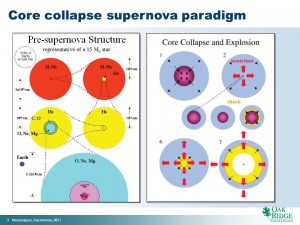
As giant stars age they use up the fuel in their core, just as all stars do, but the larger the star, the faster it uses up it’s fuel. When a Star gets to a certain point, hydrogen fusion in the core slows, this reduces the “gas pressure” in the core that is balancing the force of the enormous gravitational field of the star. When this happens the core begins to slowly contract, this reduces the hold on the outer layers of the star and they cool as they expand, this is how stars turn from dwarf stars, like the Sun, to Red Giants. Depending on the mass of the star, this process will continue all the way through the elements in the bottom of the periodic table until the core is full of Iron. The star will now resemble and onion, with successive layers fusing heavier elements into even heavier elements.
However, there is a problem with Iron, Iron requires more energy to fuse into heavier elements than the reaction releases. This results in the core slowly contracting until the mass of Iron reaches the Chandrasekhar limit of 1.4 Solar Masses. At this point the core is crushed by the gravity of the star in milliseconds, as the core collapses all the materials making it is crushed even smaller, then it reaches a point called Neutron degeneracy, where all the protons and electrons have been squeezed together to form Neutrons, the core has become a Neutron Star, but as this happens, the outer layers collapse inwards too, the core momentarily rebounds as it reaches the Neutron limit,. emitting huge quantities of Neutrinos in the process.
When the Neutrinos and the rebounding core meet the collapsing outer layers, they heat, create a massive shock wave, and the result is a Supernova Explosion.
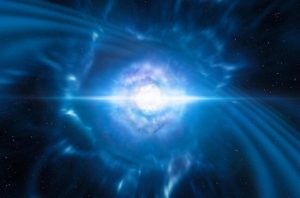
Only one such event has been positively confirmed, others likely missed or miss identified. This is the name coined for gargantuan explosions caused when two Neutron Stars collide. The first such event was observed in 2016 by multiple observatories and by LIGO, the gravitational wave detector.
Further Reading
Modjaz, M. et al., (2009), “From Shock Breakout to Peak and Beyond: Extensive Panchromatic Observations of the Type Ib Supernova 2008D associated with Swift X-ray Transient 080109”, ApJ, 702, 226 [as pdf ]
Modjaz, Kirshner, Blondin, Challis, & Matheson (2008a), “Double-peaked Oxygen Lines Are not Rare in Nebular Spectra of Core-Collapse Supernovae”, ApJL, 687, L9 [as pdf ]
Tominaga, N. et al. (2005), “The Unique Type Ib Supernova 2005bf: A WN Star Explosion Model for Peculiar Light Curves and Spectra”, ApJ, 633,L97
Modjaz, M. et al., “Optical and NIR Light Curves and Spectra of 30 Type Ib, IIb and Ic Supernovae”, in preparation
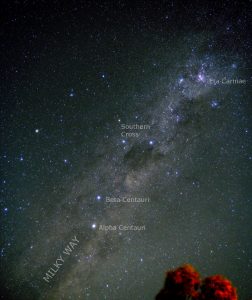
It is believed that before Western Sailors ventured south enough to see Eta Carina, once called Eta Argus, that is was the brightest star in the sky as seen from Earth, perhaps as bright as magnitude -4.3, however, since it was discovered by Western astronomers and previously by sailors, it was not this bright, it sat at around magnitude +4.2 right up until the 1830’s.
Western Astronomers had not paid much attention to this not overly bright and seemingly average star, little did they know that this is one of our galaxy’s true giants, a type we now call a Galactic Hypergiant.
This all changed in the spring of 1837 when this apparently unassuming average star underwent a massive brightening event that saw it rival mighty Rigel (β Orionis ) and may have actually achieved a visual brightness of -1.5 for a very short period. This was the start of a period now called “The Great Eruption” and it saw the star rise to become the second brightest star in the entire sky in <arch 1843, before it had faded back below naked eye visibility by 1856.
This peeked interest in the star, so it was keenly observed by a number of astronomers of the day. In 1892 it had another smaller eruption, rising to the 6th magnitude before it once again faded.
Astronomers proposed a number for idea for the outbursts, although they knew too little about the inner working of stars to have an credible theories.
Sometime in the 1940’s Eta Carina began to increase in brightness again, when it actually happened in unsure, there was a war on you know, but since then it has steadily rose in brightness to its current magnitude 4.5.
So what is going on?
That is a very good question that has been asked consistently since the late 1830’s. Today we have a distinct advantage over our long lost forbears, not only do we have truly colossal telescopes compared to them, we have orbital missions that can probe the star in everything from gamma rays through UV, visible light, IR and even microwave, and what have we learnt in all that time…?
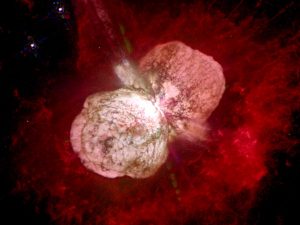
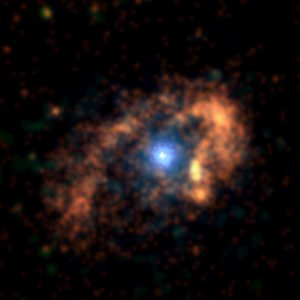
Eta Carina is embedded in a twin area of nebulosity know as The Humunculus and the Little Humunculus. the former caused by the eruption in 1837-1843 and the latter most likely resulting from the outburst in 1892.
Eta Carina is a member of Trumpler 16 (Tr16), a massive OII star formation region some 7500ly from Earth, Eta Carina is in fact a double star system, consisting of two true giants, Eta Carina A is a colossal 100 times the mass of the Sun, whereas Eta Carina B is estimated to have a mass in the range of 30-80 times the mass of the Sun, no slouch in it’s own right.
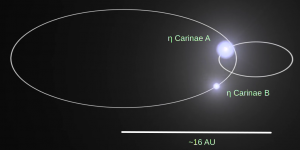
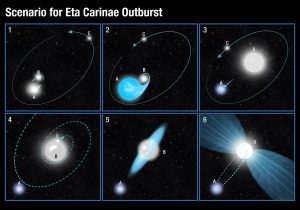
Eta Carina B appears to be in a 5.54 year orbit of the primary based on modern observation which show in increase in X-ray emissions every 5.54 years, it may indicate that the star is passing through the extended outer envelope of Eta Carina A. See the images for a theoretical orbit of the pair.
Now, studying light from the outburst that rebounded, or “echoed,” off interstellar dust that has only recently reached Earth, researchers have found the original explosion created an astounding ~12 solar mass cloud of debris expanding more than 20 times faster than anyone ever expected, some 8890 km/s, or more than 32 million km/hr. That is fast enough to cross our entire solar system in a matter of days.
So far, velocities that high have only been seen in the aftermath of supernova explosions, not in events that leave a star intact, not even the smaller Nova eruptions of stars see velocities that high.
So did Eta Carina actually undergo a Supernova event in 1837? Clearly the answer is appears to be NO because the stars are still there, so what is happening?
“We see these really high velocities in a star that seems to have had a powerful explosion, but somehow the star survived,” said Nathan Smith of the University of Arizona. “The easiest way to do this is with a shock wave that exits the star and accelerates material to very high speeds.”
Smith and Rest, of the Space Telescope Science Institute in Baltimore, wrote a pair of papers in The Monthly Notices of the Royal Astronomical Society describing the recent observations and offering a possible explanation.
Researchers first detected the light echoes from Eta Carina back in 2003, using telescopes at the Cerro Tololo Observatory in Chile. Later they secured observing time on the larger Magellan telescopes and Gemini South Observatory, also in Chile, the team collected spectra to allow them to determine the velocity of the expanding debris.. the data they collected simply did not fit with accepted ideas about stellar evolution.
As we have discussed in earlier posts, massive stars normally die when their cores run out of fuel so the outward pressure of fusion generated energy suddenly stops, gravity takes over and we see a core collapses, resulting in the tremendous shock wave that blows the outer layers of the star into space. Current theory holds that, depending on the mass of the progenitor star, it either creates a neutron star, or possibly a stellar mass black hole..
In the case of Eta Carina’s eruption, an unknown process must have produced event that resulted in supernova like shockwave, but came it must have been short of enough energy needed to destroy the star.
What might have happened?
Smith and Armin posit that Eta Carina may have been a triple star system with two massive stars orbiting close together as a binary system with the third star, possibly a few solar masses, orbiting the binary pair.
As the more massive of the binary pair aged, it expanded, filled it’s Roche Lobe and started to exchange it’s outer layers with the other star within the binary.
This second star took a huge amount from the expanded giant, swelling to around 100 times the mass of the Sun, in the process it striped away the dying star’s outer atmosphere, thus leaving an exposed helium core estimated to be around 30 times more massive than the Sun.
“From stellar evolution, there’s a pretty firm understanding that more massive stars live their lives more quickly and less massive stars have longer lifetimes, So the hot companion star seems to be further along in its evolution, even though it is now a much less massive star than the one it is orbiting. That doesn’t make sense without a transfer of mass.” Rest, 2015 Interview.
The transfer of mass from one star to the other would dramatically alter the gravitational balance and architecture of this unusual stellar system, allowing the helium core star to move away from its younger, but now significantly larger, partner, so far, in fact, that gravitational perturbations with the proposed Eta Carina C caused it to spiral inwards toward the binary pair.
The fate of Eta Carina C was sealed, nothing could stop the inevitable collision with the now supermassive star at the heart of the system, resulting in an explosion of gargantuan proportions, reminiscent of a Type II supernova.
In its initial stages, ejected material would have moved relatively slowly as the stars spiralled closer and closer together. When the they finally merged, debris was blown away more than 100 times faster than previous ejecta, catching up and ramming into the slower moving material, generating the colossal output seen ion the 1837-1843 eruption.
The helium-core star, meanwhile, ended up in a short period elliptical orbit that carries it through the giant central star’s outer atmosphere every 5.4 years, generating X-rays and shock waves.
The now binary system shines more than 5 million times brighter than out Sun, inside the massive ejection cloud we see as the Humunculus nebula.
The Future
The future of both stars is sealed, both are so massive that both will end their lives as Supernova. Eta Carina B is now the less massive star, but it is highly evolved, the helium shell is undoubtedly burning heavier elements beneath it’s layers, so when this will erupt as a type Ia supernova is pure speculation.
Eta Carina A is doomed, as a Galactic Hypergiant it now has no escape route to it’s ultimate fate, as it burns hydrogen as a prodigious rate the core will fill up with helium ash, the star will expand to even more colossal proportions, will it also absorb it’s older family member, who knows, but at an average orbital separation of around 15.5 AU (2,320,000,000km), or about half way between Saturn and Uranus in our Solar system, there is good reason to think that it too will be absorbed as it already appears to pass through the outer atmosphere already, perhaps this is already the start of it’s death dive.
Of course any star around naked eye visibility erupting as a supernova would be a pot of gold for researchers and amateurs alike. Not only would it be a spectacular visual site, but information gleaned from such a nearby event would be, literally, astronomical. The fact that such a huge star would be the culprit would make it even more special, not only would we learn a huge amount about the immediate events following such a core collapse event close up, but we would get valuable information about how such an event would impact the other star in this binary system and the massive nebula already surrounding this binary pair.
Just an end note, the absolute magnitude of Eta Carina is -8.6, to put that in perspective, Venus at it’s closest can reach -4.4 magnitude and the full Moon is magnitude -12.7. This would make Eta Carina some 80 times brighter than Venus is it were only 32.6 light years away, what a spectacle that would be.
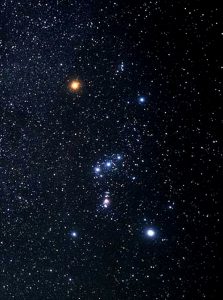
There has been quite a bit of discussion of late regarding the dimming of the star α Orionis (Alpha Orionis) or commonly known as Betelgeuse.
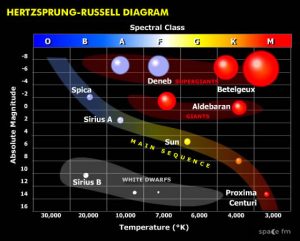
Betelgeuse is a semi-regular variable Supergiant Star that is located to the upper right of the attached Hertzsprung-Russel diagram. It is classified as spectral class M1-M 2-1a to ab. The classification depends on where, in the variability cycle, the star happens to be when observed.
The star is evolved, hence it being a Red Supergiant, but don’t be lulled into thinking a star is red due to its age, or in fact its size, although these are factors in Betelgeuse’s case. Stars of all sizes can be any of the spectral classes (O-B-F-A-G-K-M).
The colour of a star is indicative of the temperature of the photosphere, or visible surface. The age is only a secondary indicator. Red giants, or red galactic hyper giants are red simply because they are very bloated and their outer layers cool down. Red dwarves are compact, but produce little energy, compared to larger stars, thus their surfaces are cooler than our Sun and appear Redder. (Again, see the H-R diagram attached)
Red stars have surface temperatures between 3200°K and 4600°K. Stars are classified by their colour temperature using the spectral classes;
O = 40,000°K plus
B = 15,000 to 30,000°K
A = 7500 to 9500°K
F = 6500 to 7500°K
G = 4800 to 6400°K
K = 3300 to 4600°K
M = 2800 to 3200°K
The OBAFGKM spectral sequence has recently been extended to include class L (objects with temperature around 2000 Kelvin) and class T (with temperature less than 1300 Kelvin). Objects of spectral type L and T are not (technically speaking) stars at all, since they are not hot enough for fusion to occur in their cores. These are the brown dwarfs that are sometimes referred to as failed stars.
Betelgeuse is likely variable due to pulsations, caused by convection in the photosphere,visible surface, these variations can cause the star to vary from +0.0 to +1.5 visual magnitude. Currently the star is around 1.2 magnitude (+/-0.25 mag). (Thanks to Tom Polakis for the corrected light curve data)
The mass of Betelgeuse, and the distance to the star, have been a hot topic for a long time. It was once believed to be physically associated with the Orion OB1 association and at a distance of around 1500 light years (460 parsecs), this would put the mass of the star as high as 50 solar masses, a true Galactic giant. However, in recent decades both these figures have been corrected downwards thanks to more accurate parallax measurements.
Data from both the Hyparcos and Gaia missions indicates it to have been ejected from the Orion OB1 association and is rushing though space at a speed of +30km/s relative to Earth, creating an almost 4 light year wide bow shock in the surrounding space and that Betelgeuse to be around 640 (=/-15) light years (196 parsecs), which would indicate a mass of range of 17 to 25 solar masses, however a new approach to mass calculation for single stars has indicated a mass of 11(+/-3) solar masses. The mass determination is a critical factor is calculating the life span of the star.
The star is believed to be approximately 10 million years old and moved off the main sequence between 500,000 years and 2 million years ago, this uncertainty is a result of the mass uncertainty. Stars of 10 solar masses will live up to 20 million years, but stars of 20 solar masses may only live for a maximum of 10 million years. Without knowing the exact mass of Betelgeuse, it is hard to estimate how long it is before it undergoes the core collapse phase.
Most researchers believe that Betelgeuse will one day end it’s days in a spectacular type II supernova, and that this can be expected no sooner than 10,000 years but no later than 1 million years in the future, however, this is not certain either, some researchers believe that some stars below around 20 solar masses may be able to shed enough material in their Red Supergiant phase to avoid the catastrophic core collapse that is required for a supernova to occur – this is dependent on the amount of mass the star is able to shed via the stellar wind and other processes, if the star still has a final mass <8 solar masses, then core collapse is inevitable and so is a supernova explosion.
Whilst Betelgeuse may become a supernova, it is not the only star in the sky capable of this, Antares is an M1.5-1a to 1b Red Supergiant that is also around 10 million years old and some 550 light years (168 parsecs), with a mass ranging from 11-14.3 solar masses, it is also approaching the end of it’s life and would be a supernova even brighter than Betelgeuse due to the proximity of the star.
These stars are so far away they present no danger to live on Earth, Yes, after a few million years, there may be a slightly higher influx of charged particles from their direction, but unless you were naked in space, they would not present any greater hazard than the normal background radiation – and if you were naked in space, you would be dead so it’s an irrelevance.
There are around 37 stars that are visible to amateur equipment, some even the naked eye, that are believed to be supernova candidates, in fact, Rigel A, also in Orion, is one of them, a B8-1a Blue Supergiant with a mass at least 21 times that of the Sun. It was once believed that only Red Supergiants exploded as supernova, then in 1986 Sanduleak-69+202, a Blue Supergiant star in the Large Magellanic cloud exploded without any warning, it became Supernova SN1987A, thus changing how we understood which stars will or can erupt as supernova.
I hope this post clears up any concerns anyone has about Betelgeuse and the recent hype about the star becoming a Supernova, and any threat it may pose to life on Earth.
EDIT: Tom Polakis, of The Lowell Observatory, supplied an updated data set from the AAVSO which give an accurate figure for the visual magnitude of Betelgeuse.